
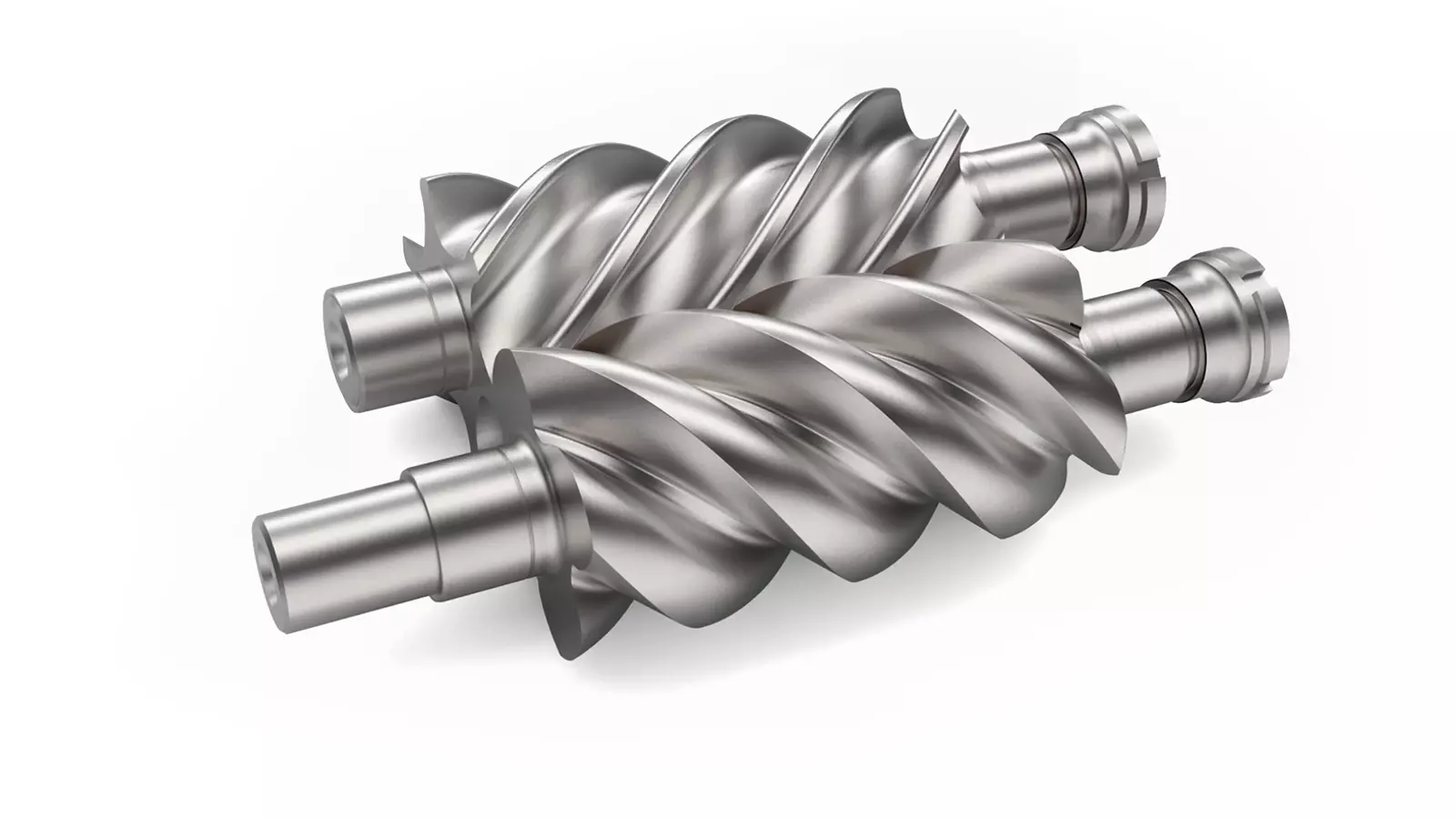
A screw compressor is one of the most widely used compressed-air systems in industrial utility plants. This guide explains how a screw compressor works, its major advantages and limitations, oil requirements, service life, sizing considerations, and the key factors utility engineers should evaluate before purchasing or operating one.
For utility engineers, understanding screw compressor technology is essential for maintaining a reliable compressed-air supply, controlling energy consumption, planning maintenance, and improving overall plant efficiency.
What Is a Screw Compressor?
A screw compressor is a positive-displacement air compressor that compresses ambient air using two rotating screw rotors installed inside a compressor housing. As the rotors turn, air is drawn into the compression chamber, trapped between the rotor profiles, and progressively compressed before being discharged.
Screw compressors are widely used for industrial compressed-air generation because they can provide a continuous and reliable supply of compressed air. They are commonly found in manufacturing plants, process industries, pharmaceutical facilities, food-processing plants, workshops, and other applications where compressed air is required continuously.
For utility engineers, the main considerations when selecting a screw compressor include:
- Required air flow
- Operating pressure
- Load profile
- Compressor operating hours
- Air quality requirements
- Energy efficiency
- Cooling requirements
- Maintenance requirements
- Available installation space
Screw compressor technology has been developed and optimized over many years, making it a proven solution for continuous industrial operation.
Screw Compressor Function and Construction
A screw compressor operates according to the principle of positive displacement. The compressor traps a specific volume of air and reduces its volume through the rotation of the screw rotors, increasing the air pressure.
Screw compressors are widely used in industrial utility systems because of their efficiency, reliability, and ability to operate continuously.
Typical screw compressor systems include components such as:
- Air inlet system
- Screw air-end
- Electric motor
- Oil circulation system in oil-injected models
- Oil separator
- Air and oil filters
- Cooling system
- Control system
- Pressure regulation system
- Air outlet system
The exact configuration varies depending on the compressor design and application.
For plants requiring a dependable compressed-air supply around the clock, screw compressors are often preferred over reciprocating compressors because of their suitability for continuous operation and relatively low vibration.
When Is a Screw Compressor Suitable?
A conventional screw compressor is particularly suitable for applications requiring continuous compressed-air production, including plants operating multiple shifts or 24/7.
For utility engineers, a screw compressor can be a practical choice when the compressed-air demand remains relatively stable for extended operating periods.
Screw Compressor for Variable Air Demand
Where compressed-air demand changes significantly throughout the day or between production shifts, a Variable Speed Drive (VSD) screw compressor can be considered.
A VSD screw compressor adjusts motor speed according to the required air demand. This can help reduce unnecessary energy consumption during periods when the plant requires less compressed air.
VSD technology can be particularly useful when:
- Plant air demand varies throughout the day.
- Production operates in multiple shifts.
- Compressor loading and unloading losses are significant.
- Future plant expansion is expected.
- Energy efficiency is a major operating objective.
The compressor should still be correctly sized based on actual measured compressed-air demand rather than simply selecting a larger compressor for future requirements.
Screw Compressor Advantages
Screw compressors provide several advantages for industrial utility applications:
- High efficiency: Screw compressors can provide a continuous flow of compressed air and can be highly efficient when correctly sized and operated.
- Compact design: They generally require less floor space than reciprocating compressors with comparable capacity.
- Continuous operation: Screw compressors are well suited to plants that require compressed air continuously.
- Low vibration: Compared with many reciprocating compressor systems, screw compressors generally produce lower vibration.
- Lower noise: Modern screw compressors can provide relatively quiet operation when properly installed.
- Reduced maintenance: Their design has fewer major moving parts than reciprocating compressors, which can simplify routine maintenance.
- Reliable operation: Properly selected and maintained screw compressors can provide dependable compressed-air service for industrial plants.
For utility engineers, these advantages can translate into improved equipment availability and easier integration into centralized compressed-air systems.
Screw Compressor Disadvantages
Although screw compressors are highly suitable for many industrial applications, they are not the best choice for every operating condition.
Low-Demand Operation
Screw compressors are generally designed for continuous operation. If a plant has very low or highly intermittent compressed-air demand, operating a large screw compressor can result in inefficient operation.
Utility engineers should therefore evaluate the actual demand profile before selecting compressor capacity.
Energy Consumption
A screw compressor can be energy efficient, but efficiency depends heavily on compressor technology, sizing, control strategy, operating pressure, and load profile.
Older or incorrectly sized compressors may consume significantly more energy than modern high-efficiency systems.
Regular monitoring of compressor power consumption, pressure, flow, and operating hours can help identify opportunities for improvement.
Initial Cost
A screw compressor may have a higher initial purchase cost than a basic reciprocating compressor.
However, the purchase price is only one part of the total cost of ownership. For industrial utility systems, electricity consumption over the operating life of the compressor can represent a major portion of the overall cost.
Therefore, compressor selection should consider both capital cost and life-cycle operating cost.
What Oil Is Used in a Screw Compressor?
Synthetic compressor oil is commonly used in oil-injected screw compressors because it is formulated to withstand the high temperatures, pressures, and continuous operating conditions found in compressed-air systems. High-quality compressor lubricants provide good thermal and oxidation stability while helping maintain reliable compressor performance.
The lubricant also helps reduce friction, remove heat, seal the rotor clearances, and protect internal components from wear and deposits. Depending on the lubricant formulation, it can also help manage moisture and contaminants within the oil circuit.
When selecting compressor oil, utility engineers should always check the oil specification and viscosity recommended by the compressor manufacturer. Different screw compressor models may require different lubricant formulations based on their design, operating pressure, temperature, and duty cycle.
Regular oil inspection and replacement should be carried out according to the manufacturer’s recommended service interval. Monitoring oil condition, operating temperature, contamination, and running hours can help maintain compressor efficiency, reduce component wear, and extend the overall service life of the screw compressor.
What Is the Lifespan of a Screw Compressor?
The service life of a screw compressor depends on several factors, including compressor design, component quality, operating conditions, operating hours, load profile, ambient temperature, cooling conditions, compressed-air quality, lubricant quality, maintenance practices, and the specific application. A properly selected, operated, and maintained screw compressor can provide reliable service for many years.
Regular maintenance is essential for maximizing the lifespan of a screw compressor. Utility engineers should monitor oil condition and level, replace air and oil filters at the recommended intervals, inspect components for wear or damage, check for air and oil leaks, monitor operating temperatures, and follow the manufacturer’s maintenance schedule.
For utility engineers, condition monitoring is also important for identifying potential problems before they result in unexpected downtime. Monitoring changes in temperature, pressure, vibration, oil carryover, and energy consumption can help detect abnormal operating conditions early and support reliable long-term screw compressor performance.
What Size Should a New Screw Compressor Be?
When selecting a new screw compressor, it is important to consider the plant’s operating conditions and actual compressed-air requirements. The compressor should be correctly sized according to the required air flow, operating pressure, demand profile, operating hours, and future requirements to ensure reliable and efficient performance.
For accurate screw compressor sizing, utility engineers should consider carrying out compressed-air consumption measurements during normal plant operation. An air-demand assessment can help identify actual consumption and support the selection of an efficient compressor configuration. Using measured demand as the basis for compressor selection can help avoid oversizing, reduce unnecessary energy consumption, and ensure a reliable compressed-air supply.
Buying a Screw Compressor: A Checklist
- Define Screw Compressor Requirements: Identify the required pressure, air flow, operating hours, load profile, and application requirements. Also consider future changes in compressed-air demand.
- Determine Screw Compressor Capacity: Measure actual compressed-air demand to determine average, peak, and minimum requirements. Avoid selecting compressor capacity based only on the total rated consumption of connected equipment.
- Evaluate the Total Cost of Ownership : Consider the purchase price, installation, electrical requirements, maintenance, air treatment, spare parts, cooling, and energy consumption. Lifetime energy costs can significantly affect the overall cost.
- Oil-Injected or Oil-Free Screw Compressor : Select between an oil-injected or oil-free screw compressor based on the required air quality, process requirements, contamination risks, and applicable standards.
- Define Control and System Interfaces : Check whether the compressor can integrate with plant controls, compressor sequencing, energy monitoring, remote monitoring, alarms, and centralized compressed-air management systems.
- Check Installation Space : Ensure sufficient space is available for the compressor, maintenance access, ventilation, cooling, air intake, service clearance, and future equipment expansion.
- Specify Compressed-Air Quality : Determine the required air quality for the application and select suitable treatment equipment such as dryers, filters, moisture separators, and condensate management systems.
- Evaluate Screw Compressor Energy Efficiency : Compare specific power consumption, motor efficiency, part-load performance, VSD operation, pressure settings, and unloaded power consumption to achieve lower operating costs.
- Review Maintenance Requirements : Check recommended maintenance intervals and the availability and cost of filters, separators, compressor oil, service kits, and replacement parts before purchasing.
- Check Warranty and Technical Support : Review warranty coverage and confirm the availability of service engineers, spare parts, troubleshooting assistance, and technical support in your operating region.
- Plan Installation and Commissioning : Plan electrical supply, ventilation, cooling, air intake, and drainage requirements. Commissioning should verify pressure, flow, temperature, controls, safety devices, and system integration.
- Follow Screw Compressor Safety Requirements : Follow the manufacturer’s safety instructions and applicable procedures when installing, operating, or maintaining the compressor, especially around pressurized, electrical, rotating, and hot components.
Utility Engineers – Screw Compressor Supplier
Utility Engineers supplies screw compressors for industrial compressed-air applications, supporting utility and maintenance teams with reliable compressed-air solutions for different plant requirements.
Our screw compressor solutions are suitable for a wide range of industrial applications where reliable air supply, energy efficiency, and continuous operation are important. The right compressor can be selected based on the plant’s air demand, operating pressure, flow requirements, air quality, operating hours, and energy-efficiency targets.
For utility engineers, selecting a screw compressor should go beyond the initial purchase price. Important factors include compressor efficiency, actual air demand, pressure requirements, maintenance needs, lifecycle operating costs, and future plant expansion.
Utility Engineers can support customers in identifying the appropriate screw compressor capacity and configuration based on their compressed-air requirements, helping improve system reliability and control operating costs.
If you are looking for a screw compressor supplier for industrial utility applications, Utility Engineers can provide solutions tailored to your plant’s compressed-air requirements.
Conclusion
A screw compressor can be an effective solution for industrial plants requiring a reliable and continuous compressed-air supply.
For utility engineers, the most important factors are not simply compressor capacity or purchase price. Correct sizing, efficient control, appropriate air treatment, preventive maintenance, operating pressure, load profile, and energy consumption all have a direct impact on compressed-air system performance.
A properly selected and maintained screw compressor can support reliable plant operation while helping reduce unnecessary energy and maintenance costs.