
Industrial Vacuum Pump
As a leading industrial vacuum pump manufacturer and supplier in India, we've stayed focused on energy efficiency across a wide range of industries and applications.
A Complete Guide of Industrial Vacuum Pump
Vacuum is sometimes called the fourth industrial utility, and it’s easy to see why. From the coffee mug on your table to the smartphone in your pocket, almost every product you touch in a day was made with the help of an industrial vacuum pump. These low-energy systems provide a steady supply of vacuum wherever a manufacturing process needs pressure below atmospheric levels, keeping production lines clean, efficient, and contamination-free.
An industrial vacuum pump is, at its core, an air pump built to operate with inlet pressures below atmospheric pressure. Industrial vacuum systems — often called rough or “fore” vacuum pumps — are engineered to bring pressure down from atmospheric levels to whatever a specific process demands. Several manufacturers serve this market today, with Atlas Copco recognized as one of the major industrial vacuum pump manufacturers in India.
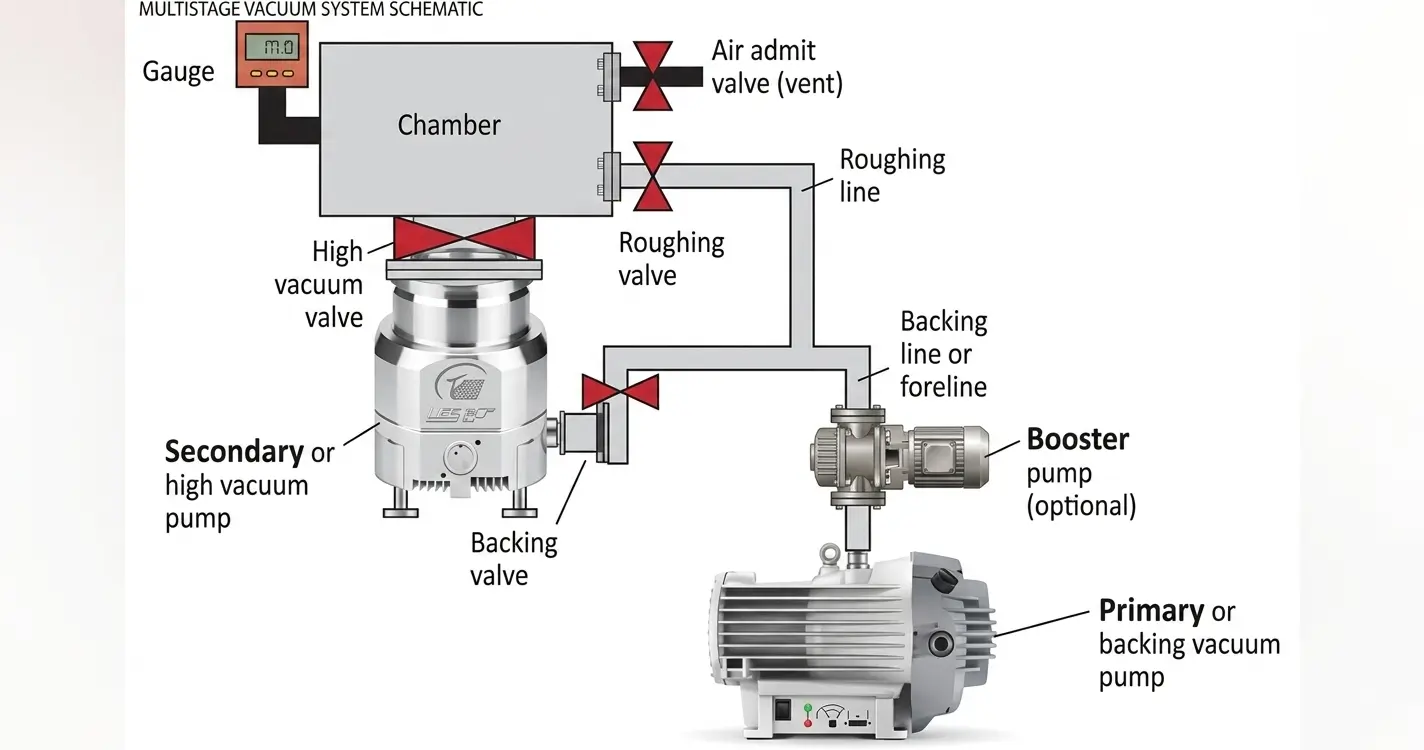
How Does an Industrial Vacuum Pump Work?
The principle behind every industrial vacuum pump traces back to the mid-17th century, when the German scientist Otto von Guericke first demonstrated the sheer force of vacuum. He showed that removing gas from the space between two hemispheres let ordinary atmospheric pressure hold them together with remarkable strength.
Modern pumps operate on that same idea. An industrial vacuum pump draws air or gas molecules from a region of lower gas density at its inlet and moves them toward a region of higher gas density at its exhaust. This makes them well suited to applications requiring:
- Low or rough vacuum — atmospheric pressure down to 1.0 mbar
- Medium vacuum — 1 mbar down to 10⁻³ mbar
Types of Industrial Vacuum Pump Technology
While the underlying physics never changes, an industrial vacuum pump can be built around very different technologies depending on the application. Broadly, they fall into two categories: wet and dry.
Wet Industrial Vacuum Pump Systems
Wet vacuum pumps use oil or water as a sealant to help move air and gas, and they split into two main families:
Oil-Sealed Vacuum Pumps mechanically trap air or gas and move it through the pump, creating progressively lower pressure at the inlet. Atlas Copco’s oil-sealed range includes:
- Oil-Sealed Rotary Vane Vacuum Pumps (single-stage and double-stage)
- Oil-Sealed Piston Pumps
- Oil-Sealed Screw Vacuum Pumps
Notably, Atlas Copco’s oil screw pump, the GHS VSD+, was recognized by the Confederation of Indian Industry as an Innovative Energy Saving Product at the 21st National Award for Excellence in Energy Management in 2020.
Liquid Ring Vacuum Pumps — also known as water-ring vacuum pumps — are among the oldest vacuum technologies still in industrial use. Water or another solvent liquid is introduced into the pump, and a rapidly rotating impeller forms a liquid ring that seals and traps air or gas molecules. Because they tolerate humid, moist, or dirty conditions so well, liquid ring pumps are typically built in large capacities for demanding environments.
Dry Industrial Vacuum Pump Systems
A dry industrial vacuum pump has no lubrication in its main pumping chamber, eliminating the risk of process contamination entirely. As a newer generation of vacuum technology, dry pumps are cleaner and more environmentally friendly since there’s no dirty oil to dispose of. Common dry pump types include:
- Side Channel Vacuum Blowers
- Dry Vane Vacuum Pumps
- Dry Claw Vacuum Pumps
- Dry Screw Vacuum Pumps
Class 0 Certification for Industrial Vacuum Pump Manufacturers & supplier
We holds global certification for producing 100% oil-free vacuum pumps, and was the first manufacturer to have its vacuum pumps independently tested for oil traces by TÜV Rheinland under the ISO 8573-1 standard.
Three pump types underwent this testing: the oil-free claw vacuum pump (DZS), the oil-free screw vacuum pump (DHS VSD+), and the liquid ring vacuum pump (LRP VSD+). All three met the strictest quality benchmarks and earned TÜV’s “Class 0” classification — confirming they are completely oil-free.

Choosing the Right Industrial Vacuum Pump for Your Application
As a leading industrial vacuum pump manufacturers & supplier in India, the focus has always been on energy efficiency across a wide range of industries and applications. Whether a facility needs a single dedicated point-of-use vacuum pump or a fully centralized industrial vacuum pump system, the right technology — wet or dry — depends on the process, the environment, and the level of vacuum required.
INTERESTED IN OUR AIR COMPRESSOR SERVICES & PARTS?
Explore our complete range of services, maintenance plans, support networks, and genuine spare parts designed to keep your compressed air systems running efficiently.
Frequently Asked Questions
Contact our experts to find the industrial vacuum pump solution best suited to your operation.