
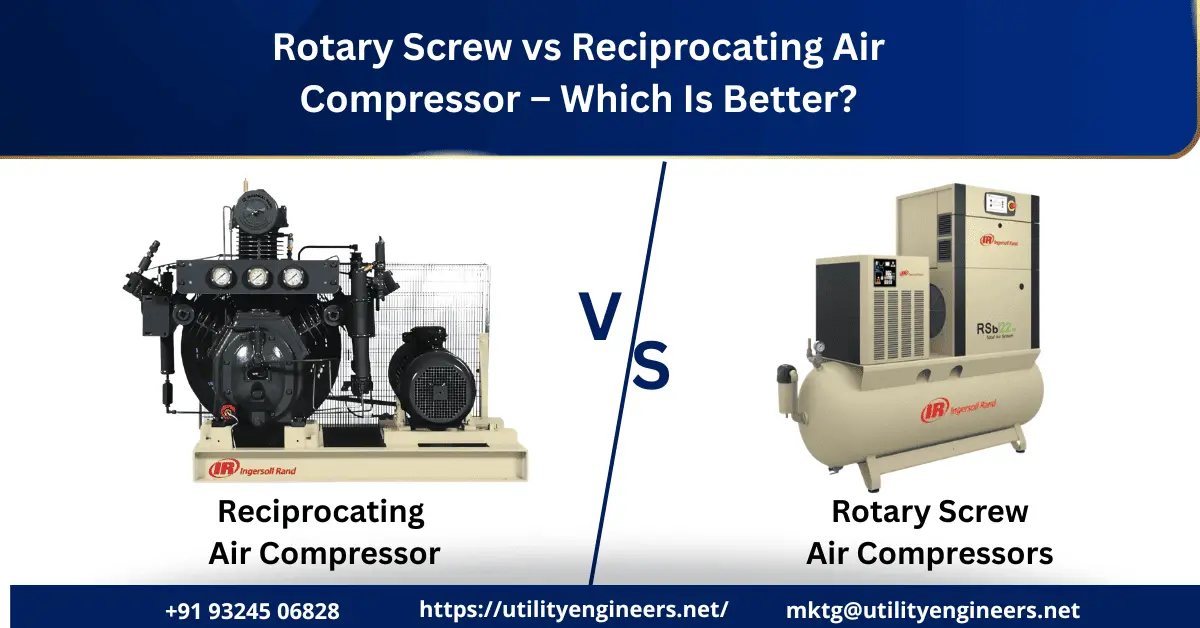
If you’re shopping for a new industrial air compressor, the choice between a rotary screw compressor and a reciprocating (piston) air compressor is one of the most consequential decisions you’ll make. Both technologies deliver compressed air — but they differ dramatically in how they work, what they cost, and what applications they’re built for.
This guide breaks down every major dimension: duty cycle, energy efficiency, maintenance requirements, lifespan, noise, and total cost of ownership. By the end, you’ll know exactly which type of air compressor fits your operation.
What is a reciprocating air compressor?
A reciprocating air compressor — also called a piston compressor — uses one or more pistons driven by a crankshaft to compress air inside a cylinder. The piston moves downward, drawing air in through an intake valve. On the upstroke, it compresses the air and forces it out through a discharge valve. This back-and-forth motion creates an intermittent stream of compressed air.
Reciprocating compressors can be single-stage (compressed in one stroke) or two-stage (compressed twice for higher pressure and efficiency). The design traces back to the industrial revolution of the late 1800s and remains largely unchanged — a testament to its reliable simplicity.
“Reciprocating compressors are the workhorse of small shops. Their simplicity makes them easy to repair — often in-house, without a service call.”
What is a rotary screw air compressor?
A rotary screw air compressor uses two meshing helical screws (rotors) that rotate inside a sealed chamber. As the interlocking spirals turn, air is drawn in, trapped between the rotor threads, and continuously compressed as it moves toward the discharge end. Unlike a piston compressor, air is being compressed the entire time the rotors are turning.
Introduced in the mid-20th century, rotary screw compressors quickly became the preferred choice for heavy industrial operations. With fewer moving parts, lower vibration, and superior continuous output, they are engineered to run non-stop under demanding conditions.
“Rotary screw compressors can run 100% of the time. For manufacturing lines, conveyor systems, or any application needing a constant air supply, there’s no contest.”
Key differences: rotary screw vs reciprocating
Reciprocating (Piston)
- Air compressed only on the upstroke — intermittent output
- Creates pulsating flow requiring a storage tank to smooth delivery
- Designed for intermittent duty cycles (typically 20–30%)
- Must cycle down to cool between compression cycles
Rotary Screw
- Air compressed continuously — smooth, steady output
- 100% duty cycle — can run non-stop without overheating
- Does not require a storage tank (though one is recommended)
- Variable speed drive models adjust RPM to match demand
Specification | Reciprocating | Rotary Screw |
|---|---|---|
Duty cycle | 20–75% (intermittent) | 100% (continuous) |
Lifespan | ~50,000 hours | 100,000+ hours |
Noise level | Up to 100 dB | Significantly quieter |
Oil carryover | 10–50 ppm | 3–8 ppm |
Internal temp | 150–200°F | 140–160°F |
Pressure band | ±10–30 PSIG | ±1.5–5 PSIG |
Max PSI (single-stage) | 120 PSI | 150 PSI |
Max PSI (two-stage) | 175 PSI | 175+ PSI |
Initial cost | Lower | Higher |
Maintenance complexity | In-house friendly | Requires skilled tech |
Dirty environments | More tolerant | Needs clean air intake |
Air quality | Good | Better |
Detailed specification comparisonEnergy efficiency
At lower horsepower (under 10 HP) and for intermittent applications, reciprocating compressors have a slight efficiency advantage. However, at higher CFM and continuous-duty applications, rotary screw compressors deliver more CFM per horsepower — largely because they produce air during 100% of their operating cycle, lose less energy to friction, and have lower internal leakage than piston designs.
A variable speed drive (VSD) rotary screw compressor takes efficiency further — by matching motor speed precisely to air demand, VSD models can reduce energy costs by up to 70% compared to fixed-speed alternatives.
Reciprocating air compressor Pros and cons
Pros
- Lower initial purchase cost (20–50% less than rotary)
- Simple design — easy in-house maintenance
- Works in dirty, dusty, or outdoor environments
- Better efficiency for low-CFM, intermittent use
- Achieves very high pressure (up to 6,000 PSI multi-stage)
- Can be sized larger to “grow into”
Cons
- Interrupted (pulsating) airflow
- Requires more frequent maintenance
- Noisy — up to 100 dB in operation
- Runs hot (150–200°F internal temps)
- Higher oil carryover in delivered air
- Shorter lifespan (~50,000 hours)
- Less reliable uptime; more unplanned downtime risk
Rotary screw air compressor Pros and cons
Pros
- 100% duty cycle — continuous compressed air delivery
- Higher CFM per HP — more efficient at scale
- Cleaner air (3–8 ppm oil carryover)
- Quiet operation — built-in sound insulation
- Longer lifespan — up to 100,000+ hours
- Lower total cost of ownership over time
- Tight pressure bands — better process control
- Cooler operating temperatures (140–160°F)
Cons
- Higher upfront capital investment
- Requires skilled technicians for maintenance
- Sensitive to dirty, dusty intake environments
- Fixed-speed models inefficient at partial load
Which is better: rotary screw or reciprocating?
Neither is universally better — the right answer depends on your air demand, duty cycle, environment, and budget. For intermittent, low-CFM applications in small shops or outdoor settings, a reciprocating compressor delivers excellent value. For high-volume, continuous-duty industrial operations where uptime, clean air, and energy efficiency matter, a rotary screw compressor is the superior long-term investment.
Not sure which compressor is right for your facility? Get a personalized recommendation based on your CFM, duty cycle, and budget.