
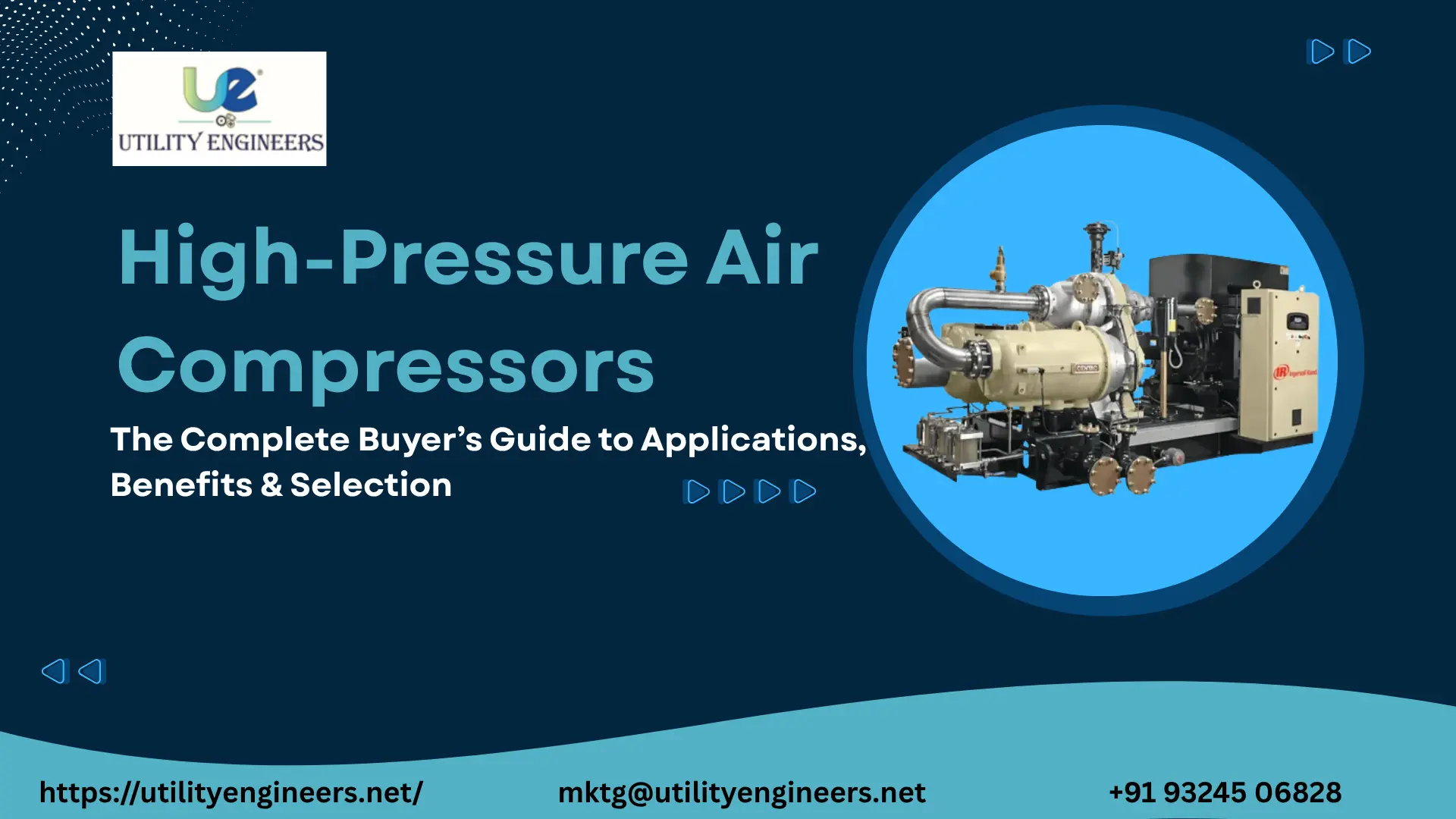
If you’ve ever tried to fill a scuba tank with a shop compressor, you already know the problem: general-purpose compressors simply can’t get you there. High-pressure air compressors exist precisely because certain jobs — PET bottle blowing, breathing air systems, pipeline testing, offshore drilling support — need air delivered at pressures far beyond what a standard workshop unit can produce.
This guide is written for buyers, not browsers. Whether you’re an operations manager sourcing equipment for a manufacturing line, a facility engineer replacing an aging unit, or a procurement lead comparing vendors, you’ll find what you actually need here: how these machines work, which type fits your application, what they cost to own, and the questions to ask before you sign a purchase order.
What Is a High-Pressure Air Compressor?
A high-pressure air compressor is a machine engineered to compress atmospheric air to pressures typically ranging from 350 psi up to 6,000+ psi — well beyond the 90–175 psi range that standard industrial compressors handle.
The distinction matters because “high pressure” isn’t just “more of the same.” At these pressures, heat generation, lubrication, sealing, and materials science all behave differently. A compressor rated for 150 psi cannot simply be run harder to reach 3,000 psi — it requires a fundamentally different design, typically involving multiple compression stages, specialized cooling, and pressure-rated components throughout the air path.
Quick reference — pressure classifications:
Classification | Typical Pressure Range | Common Use Case |
Low-pressure | Up to 150 psi | General shop air, pneumatic tools |
Medium-pressure | 150–350 psi | Plastic blow molding (light) |
High-pressure | 350–1,000 psi | PET bottle blowing, tire manufacturing |
Very high-pressure | 1,000–3,600 psi | Breathing air (SCBA/SCUBA), gas boosting |
Ultra-high-pressure | 3,600–6,000+ psi | Hydraulic testing, offshore, specialty gas |
How Does a High-Pressure Air Compressor Work?
High-pressure compressors reach their target pressure through multi-stage compression — a process where air is compressed incrementally across several cylinders or stages rather than in a single pass.
Here’s the basic sequence:
- First stage — Atmospheric air is drawn in and compressed to an intermediate pressure (often 100–150 psi).
- Intercooling — The compressed, heated air passes through an intercooler to bring the temperature back down. This step is critical: uncooled air becomes exponentially harder to compress further and risks damaging downstream components.
- Second (and subsequent) stages — The cooled air is fed into the next cylinder, which compresses it further. Most high-pressure units use 3–5 stages to reach their rated pressure.
- Aftercooling and filtration — Once at target pressure, air passes through an aftercooler and filtration/drying system to remove moisture, oil vapor, and particulates — especially important for breathing air or process applications where air purity is regulated.
- Storage or direct delivery — Compressed air is either stored in high-pressure cylinders/vessels or delivered directly to the point of use.
The reason this staged approach matters for buyers: each additional stage adds cost, maintenance points, and complexity — but also allows the compressor to reach pressures a single-stage unit physically cannot achieve without overheating or catastrophic component stress. When comparing quotes, the stage count is often the single biggest driver of price difference between two units rated for the same output pressure.
Types of High-Pressure Air Compressors
Choosing the right compressor type is the decision that most affects total cost of ownership. Here’s how the main types stack up.
Type | Pressure Range | Best For | Pros | Cons |
Reciprocating (piston) high-pressure | Up to 6,000+ psi | Breathing air, cylinder filling, testing | High pressure capability, proven technology, lower upfront cost | More maintenance, higher noise, pulsating flow |
Diaphragm compressors | Up to 5,000+ psi | Pure/hazardous gases, oxygen, hydrogen | Zero contamination risk, leak-proof seal | Lower flow rates, higher unit cost |
Booster compressors | Boosts existing supply to 3,000–6,000 psi | Topping off pressure from a lower-pressure source | Compact, efficient for boosting only | Requires existing compressed air supply |
Rotary screw (high-pressure variants) | Up to 500 psi | Continuous industrial process air | Continuous duty, smoother output, lower vibration | Limited max pressure vs. reciprocating |
Liquid (hydraulic) intensifiers | Up to 6,000+ psi | Hydrostatic testing, specialty industrial | Very high pressure, compact footprint | Narrow application range, specialized fluid handling |
Top Benefits of High-Pressure Air Compressors
- Enables processes impossible at standard pressure — PET blow molding, for example, requires 350–580 psi to properly form bottle walls; no low-pressure system can substitute.
- Reduces storage footprint — Compressed air stored at higher pressure requires smaller vessels to hold the same usable volume, which matters in space-constrained facilities like offshore platforms or mobile units.
- Improves downstream efficiency — In applications like pneumatic tools or gas boosting, higher stored pressure means longer run times between recharges.
- Supports safety-critical systems — Breathing air compressors (SCBA/SCUBA refill) are engineered specifically to very high-pressure and air-purity standards where failure isn’t an option.
- Long service life when properly maintained — Industrial-grade high-pressure units, particularly reciprocating designs, are often rated for 15–20+ years of service with proper maintenance schedules.
Industries That Use High-Pressure Compressors
Industry | Typical Application | Typical Pressure Needed |
Oil & Gas | Well testing, pipeline purging, offshore platform operations, gas lift | 1,500–6,000 psi |
Fire & Rescue / Defense | SCBA cylinder refilling for firefighters and first responders | 4,500–6,000 psi |
Diving & Marine | SCUBA tank filling for commercial and recreational diving | 3,000–4,500 psi |
Plastics & Packaging | PET bottle blow molding | 350–580 psi |
Aerospace & Defense | Wind tunnel testing, pressure vessel testing, pneumatic actuation | 3,000–6,000 psi |
Power Generation | Gas turbine starting systems, circuit breaker actuation | 200–3,000 psi |
Manufacturing (Tire/Rubber) | Tire curing and molding | 300–500 psi |
Laboratories & Research | Pressure/leak testing, specialty gas handling | Varies (up to 6,000 psi) |
If your industry isn’t listed here, the underlying question is the same one every buyer should ask: does my process require air at a pressure my current system cannot deliver, and is that pressure requirement continuous or intermittent? The answer shapes everything downstream — compressor type, storage capacity, and duty cycle rating.
Common Applications
Beyond the industry-level view, here’s where high-pressure compressors show up in day-to-day operations:
- Cylinder and tank filling — SCBA, SCUBA, and industrial gas cylinders
- Pneumatic and hydraulic testing — Pressure-testing pipelines, vessels, and valves before commissioning
- Blow molding — Forming PET plastic bottles and containers
- Gas boosting — Raising the pressure of nitrogen, CO2, or other process gases
- Starting air systems — Providing the initial pressure burst to start large diesel or gas engines
- Sandblasting and surface treatment — Some heavy-duty abrasive blasting operations require higher pressures than standard air tools
- Research and calibration — Pressure chambers and instrument calibration in labs
How to Choose the Right High-Pressure Air Compressor
This is the section that actually determines whether your purchase succeeds or becomes an expensive mistake. Work through these factors in order:
- Define your required pressure and flow rate. Don’t just specify “high pressure” — get the exact psi your application needs, plus the flow rate (CFM or SCFM) at that pressure. Undersizing flow is one of the most common and costly buying mistakes.
- Match duty cycle to actual usage. Will the compressor run continuously, or in short bursts (like cylinder filling)? Continuous-duty applications favor rotary screw or larger reciprocating units built for 100% duty cycle; intermittent use can often be served by smaller, less expensive units.
- Check air purity requirements. Breathing air, food-grade, and pharmaceutical applications require compressors and filtration systems certified to relevant purity standards (e.g., breathing air quality specifications). This isn’t optional — it’s a compliance and safety requirement.
- Evaluate total cost of ownership, not just sticker price. Compare energy consumption, maintenance intervals, filter/oil replacement costs, and expected service life across quotes — not just the upfront number.
- Consider environment and installation constraints. Offshore, mobile, or remote installations may require specific enclosure ratings, corrosion-resistant materials, or compact footprints that standard industrial units don’t offer.
- Confirm certifications and support. For regulated industries (oil & gas, defense, aerospace), confirm the manufacturer’s compressors meet relevant industry certifications, and clarify what service/support network is available in your region before you need it.
Comparison snapshot for common buyer scenarios:
Buyer Scenario | Recommended Type | Why |
Fire department refilling SCBA tanks daily | Reciprocating, breathing-air rated | Purity certification + intermittent high-pressure duty |
Bottling plant running 24/7 | Rotary screw or multi-stage reciprocating | Continuous duty cycle, efficiency at scale |
Offshore platform, space-constrained | Compact multi-stage reciprocating or booster | Small footprint, corrosion-resistant options |
Lab doing periodic pressure testing | Booster compressor | Only needs to top off existing supply intermittently |
Oxygen/hydrogen handling | Diaphragm compressor | Zero oil contamination risk |
Common Problems and Solutions
Problem | Likely Cause | Solution |
Overheating between stages | Failed or undersized intercooler | Inspect/clean intercoolers; verify cooling capacity matches duty cycle |
Excessive moisture in output air | Inadequate aftercooling or filtration | Add/upgrade dryer and filtration stage; check drain valve function |
Rapid drop in output pressure | Worn piston rings or valve leakage | Schedule valve and ring inspection; rebuild kits are often more economical than replacement |
Compressor short-cycling | Oversized unit for the load, or faulty pressure switch | Recheck sizing calculations; test/replace pressure switch |
Unusual vibration or noise | Loose mounting, worn bearings, or valve knock | Inspect mounting hardware; schedule bearing service per manufacturer interval |
Oil carryover into air stream | Worn seals or incorrect oil type/level | Verify correct lubricant spec; replace seals per maintenance schedule |
Most premature high-pressure compressor failures trace back to skipped intercooler and filter maintenance — the two components under the most continuous thermal and particulate stress. A basic weekly inspection routine catches the majority of issues before they become downtime.
FAQs
Conclusion
High-pressure air compressors aren’t a bigger version of your shop compressor — they’re purpose-built systems where stage count, cooling design, and material selection all shape whether the machine survives your application. Getting the buying decision right means starting from your actual pressure and flow requirement, matching duty cycle honestly, and pricing total cost of ownership rather than just the invoice.
If you’re evaluating options for your facility, the fastest way to avoid an expensive mismatch is to talk through your specific application — pressure, flow, duty cycle, and environment — with a specialist who can size the right system before you commit.
Ready to find the right high-pressure air compressor for your operation? Contact our engineering team today for a free application assessment and a side-by-side quote comparison tailored to your exact pressure, flow, and industry requirements.