
Why reciprocating (piston) compressors are important
Reciprocating piston compressors, also known as piston air compressors or reciprocating compressors, were among the earliest machines developed to generate compressed air. As a type of positive displacement compressor, their design has continuously evolved with advancements in engineering, materials, and manufacturing technology. Despite the availability of newer compressor technologies, reciprocating compressors remain widely used across various industries due to their reliability, efficiency, and ability to deliver consistent compressed air for a broad range of applications.
Industrial reciprocating compressors have become an essential component in a wide range of industrial operations, with demand for these positive displacement compressors continuing to increase every year. The global market for reciprocating compressors is projected to reach approximately USD 7 million by 2025, reflecting their growing importance across industries. These compressors are commonly used in oil and gas facilities, chemical processing plants, refrigeration systems utilizing ammonia and other refrigerants, automotive manufacturing, agriculture, medical applications, refineries, and many other industrial sectors. Whether you’re a student exploring compressor technology or a professional working in one of these industries, understanding reciprocating compressors is both valuable and relevant.
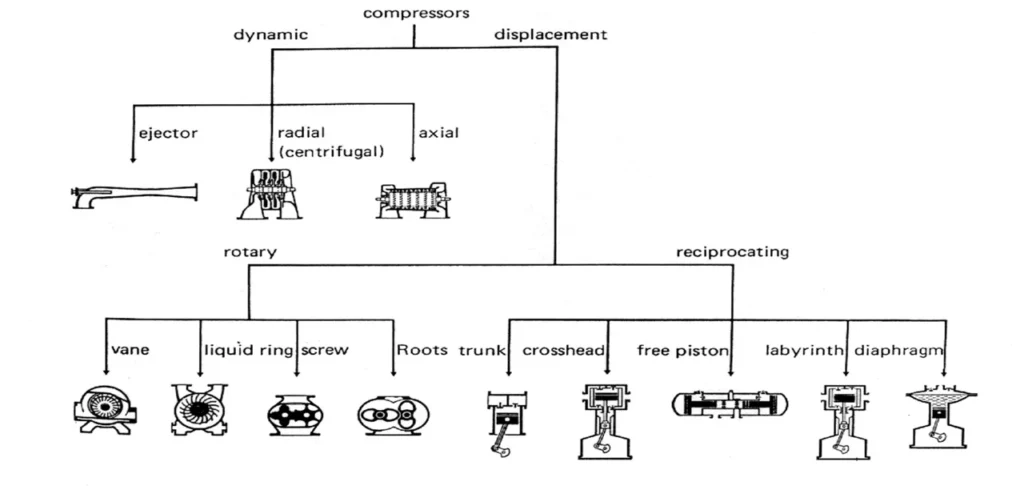
Air compressors are classified according to the operating principle they use to generate compressed air. The two primary categories are positive displacement compressors and dynamic displacement compressors, with common examples including reciprocating, rotary screw, and centrifugal compressor technologies. Each type is designed to meet specific industrial requirements based on airflow, pressure, and application.
Reciprocating compressors use positive displacement, which is a method that relies on a law of gases called Boyle’s Law.
Reciprocating Compressor Working Principle
The operating principle of a reciprocating compressor is based on Boyle’s Law, which states that the pressure of a fixed quantity of gas is inversely proportional to its volume when the temperature and amount of gas remain constant within a closed system.
According to this principle, as the volume of an enclosed gas such as air decreases, its pressure increases. In other words, pressure rises while volume falls, creating the compressed air required for industrial applications.
A reciprocating compressor works through the back-and-forth motion of a piston inside a cylinder. The piston is driven by a crankshaft and connecting rod assembly powered by an electric motor. During the suction stroke, the piston moves downward, creating a vacuum that draws air or gas into the cylinder through the inlet valve.
As the piston moves upward during the compression stroke, it reduces the cylinder’s internal volume, causing the pressure of the trapped air or gas to increase. Once the compressed gas reaches the required pressure, the discharge valve opens, allowing it to flow into the delivery system for use in a wide range of industrial processes.
This positive displacement compressor converts the rotary motion produced by the electric motor into the reciprocating movement of a piston. This back-and-forth motion compresses air or gas efficiently, making reciprocating compressors an ideal choice for applications that require high-pressure compressed air.
How to Choose the Right Industrial Reciprocating Compressor
Both positive displacement compressors and dynamic displacement compressors are designed to perform the same fundamental task—compressing air or gas to increase its pressure for industrial use.
The key difference lies in how they achieve this process and the applications they are best suited for. So, how do you determine whether a reciprocating (piston) compressor is the right choice instead of a rotary screw compressor, centrifugal compressor, or another type of dynamic displacement compressor? Understanding your pressure requirements, airflow demand, operating conditions, and intended application will help you select the most suitable compressor for your needs.
The first step in selecting the right reciprocating compressor is determining the correct compressor size for your application. This requires understanding the operating pressure (PSI) and airflow capacity (CFM) needed to meet your compressed air requirements.
Reciprocating compressors are available in a variety of sizes and configurations to suit different industrial applications. By comparing performance specifications, pressure ratings, and air delivery capacity, you can identify the model that best fits your operational needs.
One of the key advantages of reciprocating air compressors is their ability to deliver exceptionally high discharge pressures. This makes them an excellent choice for demanding applications such as PET bottle blowing, gas compression systems, and other high-pressure industrial processes.
Before investing in a reciprocating compressor, consider the following factors:
- Do you require clean, dry, or completely oil-free compressed air?
- How many operating hours will the compressor run each year?
- Will the compressor operate continuously or only during specific shifts?
- Does your compressed air demand vary throughout the day?
- Are you planning to expand your operations, and will your air requirements increase in the future?
The selection process also depends on the individual or team responsible for the purchase. Engineers often evaluate compressors based on the overall requirements of an industrial facility rather than a single application. Their decisions typically balance technical performance, project budget, installation schedules, operating conditions, maintenance needs, and future production goals.
In addition to technical specifications, it is important to consider several non-technical factors before making a purchase:
- Current and future operating conditions
- Equipment quality, brand reputation, and long-term durability
- Availability of skilled maintenance technicians
- Experience of your team with reciprocating compressor systems
- Compatibility with automation and smart control systems
- Easy access to genuine spare parts, compressor valves, and service support
- Equipment availability and delivery lead time
- Initial investment, operating expenses, and total life-cycle cost
As you can see, selecting the right reciprocating compressor involves much more than comparing technical specifications. A well-informed decision requires evaluating your application’s compressed air demand, required operating pressure, energy efficiency goals, maintenance capabilities, and long-term operational costs.
For the best results, it’s important to assess your current and future compressed air requirements before making a purchase. Consulting with an experienced compressor specialist can help you choose the most suitable solution, improve system efficiency, and reduce overall operating costs. A professional compressed air assessment or energy efficiency audit can also identify opportunities to optimize performance and lower energy consumption.
Advantages of Reciprocating Compressors
Variations in the molecular weight or composition of gases can have a significant impact on compressor performance. Compared to dynamic compressors such as rotary screw or centrifugal compressors, positive displacement compressors are better equipped to handle changes in gas composition while maintaining reliable operation.
When selecting a positive displacement compressor, it is important to understand the key advantages that reciprocating compressors provide:
The design and operating principle are straightforward, resulting in a simple and cost-effective machine. This makes reciprocating compressors economical to manufacture, install, and maintain.
Because the technology has been used for decades across multiple industries, maintenance procedures are well established, ensuring dependable performance and easy servicing.
Replacement components such as pistons, piston rings, compressor valves, suction and discharge valves, crankshafts, connecting rods, and other spare parts are readily available, making repairs faster and more affordable.
Reciprocating compressors are available in a wide range of capacities, pressure ratings, and multi-stage configurations, making them suitable for small workshops as well as large industrial facilities.
Compact belt-driven models are lightweight and portable, making them an excellent choice for mobile and site-specific applications.
These compressors deliver excellent energy efficiency and are capable of producing very high discharge pressures, making them ideal for demanding applications such as PET bottle blowing, gas compression, and industrial manufacturing.
Their proven reliability, long service life, and consistent performance make reciprocating compressors a preferred solution in industries where uninterrupted operation is essential.
Why Investing in a High-Quality Reciprocating Compressor Is a Smart Choice
Choosing a reliable reciprocating compressor is a long-term investment that improves productivity, reduces maintenance costs, and enhances overall operational efficiency. Modern compressor manufacturers continue to develop advanced technologies that deliver higher performance, greater energy efficiency, and longer equipment life.
Today’s industrial reciprocating compressors are designed with improved engineering, durable materials, and intelligent control systems to help businesses reduce downtime and maximize productivity. Selecting a compressor from a trusted supplier also ensures access to genuine spare parts, expert technical support, and dependable after-sales service throughout the equipment’s lifecycle.
It is worth noting that compressed air systems are among the largest consumers of electricity in industrial facilities, often accounting for 12% to 40% of total energy usage. Investing in an energy-efficient reciprocating compressor and maintaining it properly can significantly lower operating costs while improving the overall performance of your compressed air system.
However, not all of the energy supplied to an air compressor is converted into useful compressed air. A portion of the energy is lost during the compression process due to factors such as:
- Heat generated during compression
- Compressed air leaks within the system
- Friction between moving mechanical components
- Inefficient compressor design or outdated technology
- Inadequate maintenance and servicing
Modern reciprocating compressors are engineered to deliver excellent energy efficiency, dependable performance, and long-term reliability. Choosing a high-quality compressor from a trusted supplier can help reduce energy consumption, minimize downtime, and lower overall operating costs.
Industrial reciprocating compressors are available in a variety of configurations to meet different application requirements, including:
- Belt-driven compressors
- Direct-drive compressors
- Oil-free and dental air compressors
- PET bottle blowing compressors
- Compressed Natural Gas (CNG) compressor solutions
Selecting the right reciprocating compressor depends on factors such as pressure requirements, airflow demand, operating conditions, and industry application. Consulting an experienced compressor specialist can help you understand the working principle, key components, performance specifications, and the most suitable compressor model for your facility, ensuring maximum efficiency and long-term value.
Take advantage of our FREE Compressed Air System Audit by contacting our team today. Our experienced engineers can schedule a site visit to evaluate your compressed air system and identify opportunities to improve performance and reduce operating costs.
The audit may include a visual inspection or a comprehensive system assessment to detect air leaks, pressure drops, energy losses, and other inefficiencies. Based on the findings, we provide practical recommendations to optimize system performance, increase energy efficiency, and enhance overall productivity.
Utility Engineers Delivers Reliable Compressed Air Solutions
At Utility Engineers, we build long-term relationships with our customers by delivering reliable products, quality service, and dependable technical support. Our focus is on helping industries achieve smooth, uninterrupted operations with efficient and durable compressed air systems.
We are committed to supplying high-performance reciprocating compressors and complete compressed air solutions that improve productivity, reduce energy consumption, enhance system reliability, and minimize total life-cycle costs. With expert guidance, genuine spare parts, and responsive after-sales support, we help businesses maximize the value of their compressed air investment.