
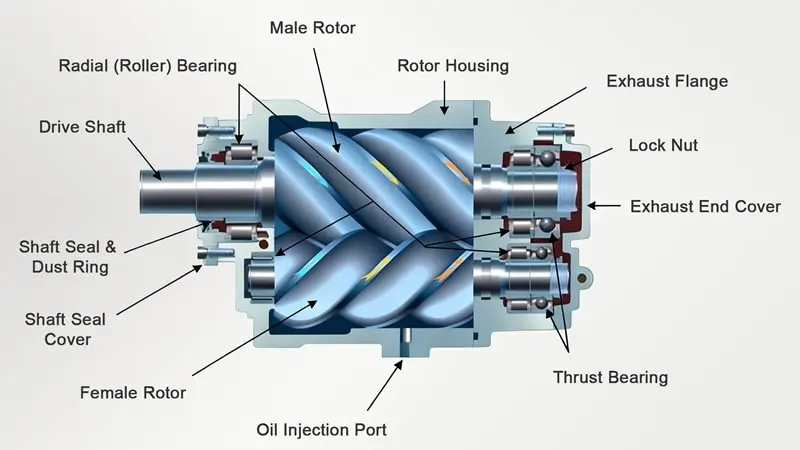
Are you looking for the ideal rotary screw air compressor for your application? Before making a decision, it’s important to understand how a screw compressor works and the different types available. In this comprehensive guide, you’ll learn the working principle of a screw compressor, explore its key components and technologies, and discover why it is a reliable and energy-efficient solution for a wide range of industrial applications.
What is a Rotary Screw Air Compressor?
A rotary screw air compressor is a positive displacement compressor that compresses air using two precisely machined helical rotors. These rotors rotate in opposite directions inside a compression chamber, trapping atmospheric air and gradually reducing its volume to increase pressure.
Because there are very few moving parts and no reciprocating motion, screw compressors operate with less vibration and lower noise than piston compressors. They are designed for continuous-duty applications and can run around the clock in manufacturing plants, workshops, pharmaceutical facilities, food processing units, automotive industries, and many other industrial environments.
Advantages of Rotary Screw Compressors
- Continuous and uninterrupted compressed air supply
- High energy efficiency
- Quiet operation
- Longer service life
- Low maintenance requirements
- Suitable for heavy industrial applications
- Consistent air pressure and flow
How Does a Screw Compressor Work?
The working principle of a screw compressor is based on positive displacement compression.
Inside the compressor are two specially designed rotors:
- Male rotor
- Female rotor
Both rotors rotate in opposite directions while maintaining extremely small clearances.
The compression process takes place in four stages.
- Air Intake -: Atmospheric air enters the compressor through the inlet valve. An air filter removes dust, moisture, and contaminants before the air reaches the compression chamber.
- Air Trapping -: As the rotors begin rotating, air becomes trapped in the spaces between the rotor lobes and the compressor housing.
- Compression -: The trapped air moves along the length of the rotors. As the available space gradually decreases, the air volume becomes smaller while its pressure increases.
- Air Discharge -: Once the compressed air reaches the designed pressure, it exits through the discharge port and moves to the air receiver or distribution system for industrial use.
Main Components of a Screw Compressor
Several components work together to ensure reliable and efficient operation.
Air Intake Filte -: Removes dust and airborne particles before air enters the compressor.
Screw Air End -: The air end contains the male and female rotors where the actual compression process takes place.
Electric Motor -: The motor provides rotational power to drive the screw element.
Oil Separator -: In oil-injected compressors, this component separates lubricating oil from compressed air before it leaves the machine.
Oil Filter -: Keeps circulating oil clean by removing contaminants and extending component life.
Cooling System -: After compression, air temperature rises significantly. An air or water cooler reduces the temperature to improve efficiency and protect downstream equipment.
Bearings -: High-quality bearings support rotor alignment and minimize mechanical friction during continuous operation.
For detailed overview of parts visit screw compressor components page.
Lubrication Methods
Rotary screw compressors are primarily available in two lubrication types: oil-injected and oil-free. The choice between these designs depends on the required air quality, operating conditions, and the specific needs of the application. While oil-injected compressors are commonly used for general industrial purposes, oil-free compressors are designed for industries where clean, contamination-free compressed air is essential.
Oil-Injected Screw Compressors -: Oil-injected screw compressors use lubricating oil inside the compression chamber to support the compression process. The oil lubricates the rotating components, absorbs the heat generated during compression, seals the small clearances between the rotors to improve efficiency, and reduces wear on internal parts. After the compression cycle, the oil is separated from the compressed air, filtered, cooled, and recirculated back into the system. Due to their durability, high efficiency, and cost-effectiveness, oil-injected compressors are widely used in manufacturing plants, engineering workshops, automotive industries, textile factories, packaging facilities, and other general industrial applications.
Oil-Free Screw Compressors -: Oil-free screw compressors compress air without introducing lubricating oil into the compression chamber. Instead, precision timing gears keep the male and female rotors perfectly synchronized, preventing them from coming into contact with each other. Since no oil is used during compression, the system delivers clean, oil-free compressed air that meets the strict air quality standards required by sensitive industries. Oil-free screw compressors are commonly used in food and beverage processing, pharmaceutical manufacturing, hospitals and medical facilities, electronics production, chemical processing, and other applications where even small amounts of oil contamination cannot be tolerated.
Read more about the differences between oil-free and oil-lubricated compressors.
Speed Control Methods
Modern rotary screw compressors are available with different speed control methods to match varying air demand and improve overall energy efficiency. The three most common types are fixed-speed, variable speed drive (VSD), and dual-speed compressors. Each method offers unique advantages depending on the operating conditions and compressed air requirements.
Fixed Speed Compressors -: A fixed-speed screw compressor operates at a constant motor speed whenever it is running. It performs best in applications with a steady and predictable air demand. When compressed air consumption decreases, the compressor enters an unloaded state, but the motor continues to run, consuming electricity even though little or no compressed air is being produced. Fixed-speed compressors are a cost-effective solution for facilities with consistent workloads, single-shift operations, and minimal fluctuations in air demand.
Variable Speed Drive (VSD) Compressors -: Variable Speed Drive (VSD) compressors automatically adjust the motor speed based on the actual compressed air demand. As air consumption increases, the motor speeds up to deliver additional airflow, and when demand decreases, it slows down to reduce energy usage. This intelligent operation minimizes power consumption, maintains stable system pressure, and reduces unnecessary energy losses. VSD compressors are ideal for industries with changing air requirements, offering lower electricity costs, improved efficiency, longer equipment life, and reduced environmental impact.
Dual-Speed Compressors -: Dual-speed compressors combine the advantages of fixed-speed and variable-speed operation by running at two different motor speeds. During periods of high air demand, the compressor operates at full speed, while during low-demand conditions it automatically switches to a lower speed instead of remaining fully unloaded. This reduces energy consumption, minimizes idle losses, and helps maintain a consistent air supply. Dual-speed compressors are a practical option for facilities with moderate fluctuations in compressed air demand while providing better efficiency than conventional fixed-speed models.
Drive Types of Rotary Screw Compressors
The drive system plays a crucial role in determining the efficiency, reliability, maintenance requirements, and operating cost of a rotary screw compressor. The three most common drive types are belt drive, gear drive, and direct drive, each offering unique advantages depending on your application and budget.
Belt Drive -: Belt-driven rotary screw compressors use a belt and pulley system to transfer power from the motor to the compressor element. These compressors are known for their simple design, making installation, maintenance, and belt replacement straightforward. They also have a lower purchase price than other drive systems, making them an economical option for small workshops and light industrial applications. However, belt drives experience some power loss during transmission, making them less energy-efficient than gear or direct drive compressors.
Gear Drive -: Gear-driven compressors use precision gears to transfer power directly from the motor to the air end. This design improves power transmission efficiency while reducing slippage and maintenance compared to belt-driven systems. Gear drive compressors are ideal for industries that require continuous operation and high air demand. Although they have a higher initial investment, their improved efficiency and lower energy consumption can reduce operating costs over the compressor’s lifespan.
Direct Drive -: Direct drive compressors connect the motor directly to the compressor air end without using belts or gears. This eliminates transmission losses and delivers maximum energy efficiency. When combined with a Variable Speed Drive (VSD), direct drive compressors automatically adjust motor speed to match air demand, helping reduce electricity consumption and maintain stable system pressure. They are also the quietest and most reliable option, making them an excellent choice for demanding industrial applications where efficiency and long-term performance are priorities.
How to Choose the Right Screw Compressor
Choosing the right screw compressor depends on your air requirements, operating conditions, and long-term business goals. Factors such as airflow, working pressure, duty cycle, air quality requirements, and energy efficiency all play an important role in selecting the most suitable compressor. Evaluating these requirements carefully helps ensure reliable performance, lower operating costs, and maximum productivity.
To make the right choice, consider the following factors:
- Air Flow (CFM)
- Working Pressure (Bar or PSI)
- Duty Cycle
- Air Quality Requirements
- Energy Efficiency
Why Energy Efficiency Matters
Although the purchase price is important, operating costs usually represent the largest expense over a compressor’s lifetime.
Electricity consumption accounts for a significant portion of total ownership costs. Investing in an energy-efficient compressor—particularly a Variable Speed Drive model—can reduce energy use, lower operating expenses, and improve overall productivity.
Conclusion
Rotary screw compressors are designed to deliver reliable, continuous compressed air with excellent efficiency and durability. Their smooth compression process, low maintenance requirements, and advanced control technologies make them the preferred choice for modern industrial operations.
Whether you choose an oil-injected or oil-free model, fixed-speed or Variable Speed Drive, selecting the right compressor depends on your air demand, pressure requirements, application, and long-term operating costs. Evaluating these factors carefully will help you achieve maximum performance, lower energy consumption, and dependable operation for years to come.