
Benefits of an Oil Free Air Compressor
Choosing an oil free air compressor offers several important advantages, especially in industries where air quality affects final product quality, process reliability, and compliance.
- Clean, Contamination-Free Air
The biggest advantage of an oil free air compressor is the ability to produce clean compressed air without the risk of oil contamination. This is essential in industries where even trace oil can ruin products or create safety issues.
- Better Product Quality
In sectors such as food, pharma, electronics, and painting, contaminated compressed air can lead to rejected batches, poor finish quality, or damaged products. An oil free system helps maintain consistent output quality.
- Reduced Risk of Regulatory Non-Compliance
Industries such as pharmaceuticals, healthcare, and food processing often have strict air purity standards. Using an oil free air compressor can help businesses meet quality and compliance requirements more easily.
- Lower Downstream Filtration Burden
Since there is no oil introduced into the air stream, the load on downstream filters and separators can be reduced. This can improve air treatment efficiency and simplify the compressed air system.
- Environmentally Friendly Operation
An oil free air compressor reduces the need for oil disposal and lowers the chance of environmental contamination due to oil leaks or carryover.
- Lower Risk of Product Recalls or Process Failure
When compressed air directly touches products, packaging, instruments, or sensitive surfaces, contamination can lead to major losses. Oil-free compression reduces that risk significantly.
- Suitable for Critical Applications
An oil free air compressor is ideal for processes where compressed air is part of the final product or production environment, such as fermentation, packaging, filling, coating, and instrument air.
What Is an Oil Free Air Compressor?
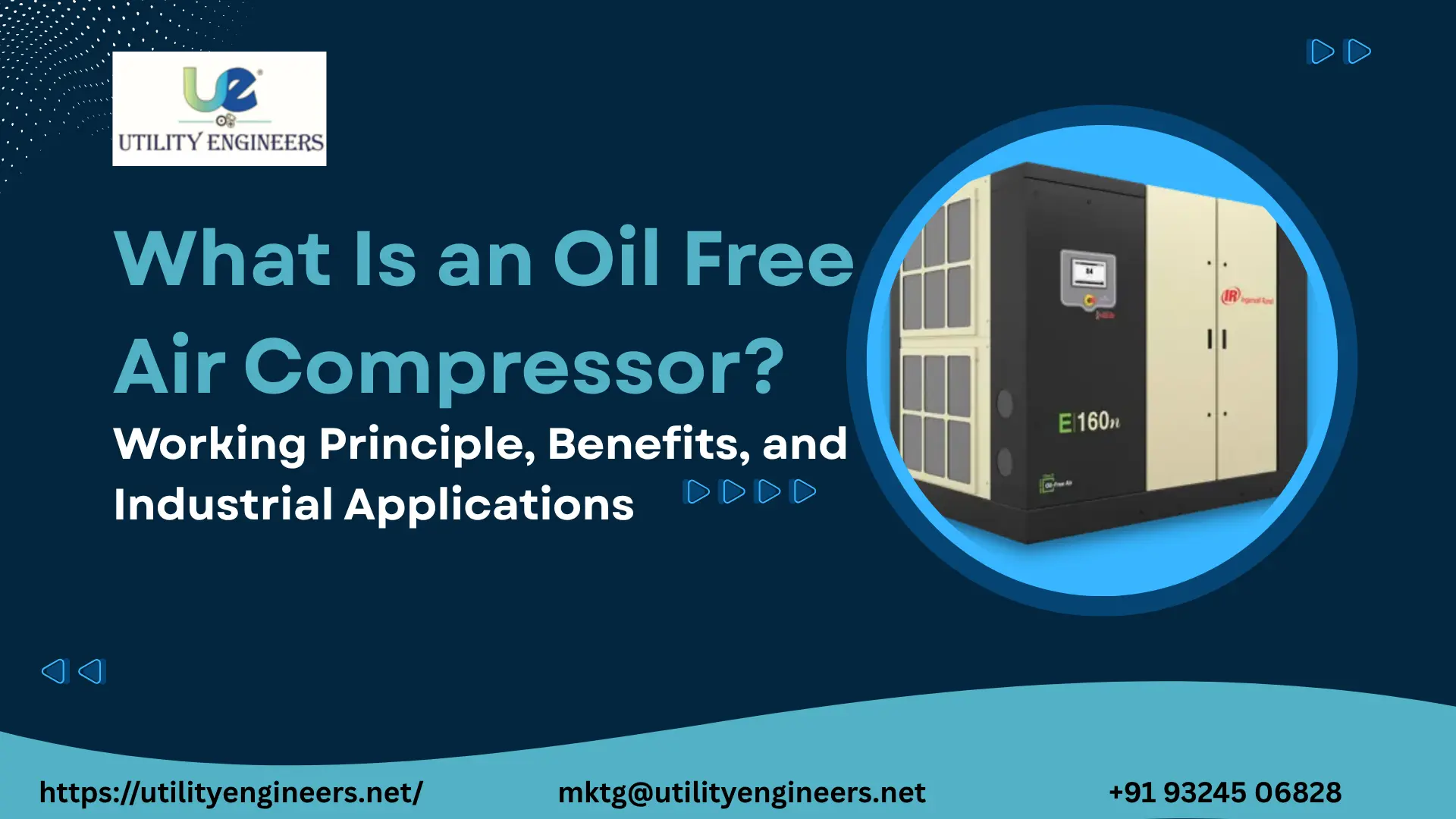
An oil free air compressor is a type of air compressor that compresses air without using oil for lubrication inside the compression chamber. Unlike conventional oil-lubricated compressors, these systems are engineered with special materials, coatings, and design features that reduce friction and wear while maintaining clean air output.
In many industrial processes, compressed air comes into direct or indirect contact with products. If the air contains traces of oil, it can contaminate sensitive products, create hygiene issues, and increase maintenance costs. Oil free compressors are designed to avoid these risks and help industries maintain high standards of air quality.
How Does an Oil Free Air Compressor Work?
The working principle of an oil free air compressor is similar to other compressors: it takes in atmospheric air, compresses it, and delivers it at a higher pressure for industrial use. The key difference is that no oil is used in the compression chamber.
Basic Working Principle
- Air Intake : Ambient air enters the compressor through an intake valve and air filter. The filter removes dust and contaminants before the air enters the compression stage.
- Compression Process : The air is compressed using one of several mechanisms, such as reciprocating pistons, rotary screws, or scroll elements. In an oil free design, these components operate without oil in the compression chamber.
- Cooling and Moisture Removal : Compression generates heat, so the compressed air is cooled using aftercoolers or integrated cooling systems. Moisture separators may also be used to remove water vapor from the air.
- Air Delivery : The clean compressed air is then delivered to the air receiver, pipeline, or directly to the application.
Types of Oil Free Air Compressors
Oil free compressors are available in different configurations depending on the application, pressure requirement, and air demand.
- Oil Free Reciprocating Air Compressor
This type uses a piston-cylinder mechanism to compress air. Special low-friction materials such as PTFE rings are used to minimize wear without oil lubrication. These compressors are often used for small to medium air demand applications.
- Oil Free Screw Air Compressor
An oil free screw compressor uses two intermeshing rotors to compress air. Since oil is not injected into the compression chamber, timing gears and special rotor coatings help maintain efficiency and reduce friction. These compressors are ideal for continuous industrial use and large air demand applications.
- Oil Free Scroll Compressor
Scroll compressors use two spiral-shaped scrolls, one fixed and one orbiting, to compress air. They are compact, quiet, and commonly used in laboratories, dental clinics, medical facilities, and light industrial applications.
Key Benefits of an Oil Free Air Compressor
Choosing an oil free compressor offers several operational and quality advantages, especially in industries where air purity matters.
- Clean and Contamination-Free Air
The biggest advantage of an oil free air compressor is the delivery of air without oil carryover from the compression chamber. This is critical in applications where compressed air directly contacts products or sensitive equipment.
- Better Product Quality
In food, beverage, pharmaceutical, and electronics manufacturing, contaminated air can damage products, spoil batches, or affect precision processes. Oil free compressed air helps maintain product integrity and reduce rejection rates.
- Reduced Risk of System Contamination
Oil contamination in air lines can affect filters, dryers, valves, pneumatic tools, and downstream equipment. Oil free compressors reduce this risk and help keep the compressed air system cleaner.
- Lower Maintenance Related to Oil Handling
Since there is no oil in the compression chamber, there is no need for oil separation in the air stream from that stage. This can reduce some maintenance requirements related to oil changes, oil filters, and oil carryover management.
- Compliance with Industry Standards
Many industries must meet strict air quality and hygiene standards. Oil free compressors are often preferred in applications where compliance, cleanliness, and process safety are essential.
- Reliable Performance in Sensitive Applications
Processes such as packaging, fermentation, instrument air, medical air supply, and electronics manufacturing depend on stable, clean compressed air. Oil free systems provide a dependable solution for these critical operations.
Applications of Oil Free Air Compressors
The demand for oil free air compressor systems is growing across industries where compressed air quality directly affects operations, hygiene, safety, or product standards.
- Food and Beverage Industry
Compressed air is often used in food packaging, bottling, conveying, sorting, fermentation, and product handling. Any oil contamination can spoil the product and affect hygiene standards.
Typical uses include:
- PET bottle blowing
- Food packaging lines
- Dairy processing
- Beverage filling systems
- Pneumatic conveying
- Pharmaceutical Industry
In pharmaceutical manufacturing, compressed air may come into contact with tablets, capsules, packaging, and process equipment. Oil contamination is unacceptable in such environments.
Typical uses include:
- Tablet coating and packaging
- Cleanroom operations
- Instrument air
- Filling and sealing lines
- Process automation
- Healthcare and Medical Applications
Hospitals, dental clinics, diagnostic labs, and medical device manufacturers require clean compressed air for equipment operation and patient-safe environments.
Common applications:
- Dental air systems
- Ventilator and medical air supply support systems
- Laboratory instruments
- Sterile packaging systems
- Electronics and Semiconductor Manufacturing
Electronic components and semiconductors require ultra-clean production environments. Even minor contamination can damage sensitive parts or affect production yield.
Applications include:
- PCB manufacturing
- Semiconductor assembly
- Precision cleaning systems
- Instrumentation and automation
- Textile Industry
Textile plants use compressed air for spinning, weaving, cleaning, and pneumatic control. In certain processes, clean air is essential to protect fabric quality and reduce contamination.
- Automotive and Paint Shops
In automotive finishing and painting, air quality directly affects paint finish. Oil contamination can cause surface defects such as fisheyes, uneven coating, and rework.
Used in:
- Spray painting
- Pneumatic tools
- Robotic painting systems
- Surface preparation lines
- Chemical and Process Industries
In process plants, clean compressed air is often needed for instrumentation, packaging, pneumatic controls, and contamination-sensitive production systems.
Oil Free Air Compressor vs Oil Lubricated Compressor
A common question among buyers is whether to choose an oil free air compressor or an oil-lubricated model. The answer depends on your application, air quality requirements, and budget.
Feature | Oil Free Air Compressor | Oil Lubricated Compressor |
Air Purity | Very high | May contain oil traces |
Best For | Food, pharma, medical, electronics | General industrial use |
Risk of Contamination | Extremely low | Higher |
Maintenance | May reduce oil-related maintenance | Requires oil changes and oil management |
Initial Cost | Usually higher | Usually lower |
Air Quality Compliance | Better suited for critical applications | May need additional filtration |
Read more about the differences between oil-free and oil-lubricated compressors.
How to Choose the Right Oil Free Air Compressor
Before selecting an oil free air compressor, consider the following points:
1. Air Quality Requirement : Understand how clean your compressed air needs to be and whether your process has strict purity standards.
2. Required Flow and Pressure : Choose the compressor capacity based on your plant’s CFM requirement and operating pressure.
3. Duty Cycle : If your application runs continuously, a rotary screw oil free air compressor may be more suitable than a small piston model.
4. Industry Standards and Compliance : Food, pharmaceutical, and healthcare industries often require specific air quality benchmarks. Make sure your compressor aligns with those needs.
5. Total Cost of Ownership : Don’t evaluate only the purchase price. Consider maintenance, energy use, filtration, downtime risk, and product quality impact.
6. After-Sales Support and Spare Availability : Reliable service, genuine spare parts, and technical support are essential for long-term compressor performance.
Maintenance Tips for an Oil Free Air Compressor
Although an oil free air compressor eliminates oil contamination in the compression chamber, regular maintenance is still necessary for efficient operation.
Best practices include:
- Inspect and replace air filters on time
- Check cooling systems regularly
- Monitor pressure and temperature performance
- Inspect seals, bearings, and moving parts
- Keep intake air clean and dust-free
- Follow the manufacturer’s preventive maintenance schedule
Proper maintenance improves efficiency, reduces downtime, and extends compressor life.
Why Businesses Choose Oil Free Air Compressors
Businesses invest in oil free air compressor systems because they offer peace of mind in contamination-sensitive environments. They help protect product quality, reduce operational risks, and support compliance in industries where compressed air is a critical utility.
While the initial investment may be higher than standard compressors, the long-term benefits can outweigh the cost when product safety, brand reputation, and production reliability are at stake.
Conclusion
An oil free air compressor is the ideal solution for industries that need clean, reliable, and contamination-free compressed air. By eliminating oil from the compression chamber, these compressors support better product quality, safer operations, and improved compliance across sectors such as food processing, pharmaceuticals, healthcare, electronics, and automotive finishing.
Whether you are planning a new compressed air installation or upgrading an existing system, choosing the right oil free air compressor can make a major difference in performance, air quality, and long-term operating efficiency.